
The short version: Host-read podcast advertising CPMs in 2026 typically run between $35 – $50 in the US, £40 – £50 in the UK, and €30 – €100+ across Europe, depending on the market. Programmatic placements are cheaper at $5 – $18 CPM. Realistic test budgets for direct-sold host read campaigns start at $40,000 – $50,000, and ongoing monthly spend for established brands runs at $40,000 – $250,000+, depending on the audience niche.
Ask ten brands what advertising brands on podcasts should cost, and you’ll get ten different answers, most of them wrong by a wide margin. The channel has grown fast. Deloitte1 now puts global podcast and vodcast ad revenue at $5 billion for 2026, a 20% jump2 on last year, and the IAB has US spend pencilled in at $2.56 billion3. Podcasts aren’t an expceriment any more. They’re a line on the media plan.
The question we keep getting is the simple one: what does it actually cost to run a campaign?
Here’s the longer version, the one that helps you actually budget. We plan and buy podcast campaigns at Media Bodies every single day, so the numbers below are the ones we work with, not a theoretical industry average pulled from a press release.
How is podcast advertising priced?
Most podcast media buying is sold on a CPM basis, meaning a flat rate per 1,000 downloads or listens. Two other models exist, but they’re the exception rather than the rule.
CPA – cost per acquisition – is the performance-marketer’s pricing. You pay when somebody actually does something: buys, signs up, downloads. Promo codes do the heavy lifting on attribution. It works, but it’s a smaller slice of the market.
Flat fees are the other option. A fixed price for a defined run of episodes, regardless of how the listener numbers shake out. Established shows tend to avoid this, but it can be a useful structure for niche podcasts where the audience is small but unusually engaged.
For most brands testing the channel, CPM is the right starting point. It’s transparent, it’s comparable across shows, and it makes campaign modelling straightforward.
How much does podcast media buying cost in 2026?
Pricing breaks down by placement, and the gaps between formats are wider than most brands realise. Here’s how the 2026 benchmarks land, drawn from Ad Results Media4, Loopex Digital5 and Podscribe6.
What is the cost of a pre-roll podcast advertising?
Pre-roll spots run 15–30 seconds and play in the first minute of an episode. Typical CPM: $15–$30. Cheap and visible, but the skip risk is real; listeners haven’t settled in yet. Best used when you’re after early brand exposure or running a short, sharp call to action that doesn’t need much room to breathe.
What is the cost of a mid-roll podcast ad?
Mid-roll spots run 60–90 seconds and play partway through an episode. Typical CPM: $25–$50+ for direct-sold, host-read placements in the US, with the UK averaging slightly higher at £40–£50 and parts of Europe higher again (more on market variation below). This is the placement that does the work. Mid-roll generates 2–3x the click-through and conversion of pre-roll (XtendedView, 2026) and accounts for roughly 64% of all podcast ad revenue. Listener attention peaks here, and host-read mid-rolls add another layer on top; the trust the host has built up over hundreds of episodes is essentially being lent to your brand for 90 seconds. Podscribe’s Q2 2025 report found host-read ads beat producer-read by 31% on purchase rate. The CPM premium reflects that.
What is the cost of a post-roll podcast ad?
Post-roll spots run 15–30 seconds and play once the show is finished. Typical CPM: $10–$20. Lowest CPM, lowest completion rate, lowest entry cost. It is worth a look if you’re testing the channel cheaply, or if your audience is the kind of devoted listener who stays to the very end. Otherwise, it’s a hard sell against mid-roll.
What is the cost of programmatic advertising?
Programmatic placements use dynamic ad insertion (DAI). Typical CPM: $5–$18, with the buy type making a big difference. We recently ran an EU campaign that came in at €13.40 CPM for open exchange audio, €17 CPM for a private marketplace (PMP) deal, and €72 CPM for the host read portion, thus illustrating the typical 4-5x gap between programmatic and host-read pricing in the same market. Dynamic ad insertion now accounts for around 90% of podcast ad revenue by delivery method, and you can target by geography, demographic and interest at a scale that didn’t exist five years ago. The catch is that programmatic spots are usually producer-read rather than host-read, so you lose the endorsement effect. The smart play in 2026 is to use programmatic for reach and awareness, and reserve direct host-read buys for the conversion work.
How do podcast ad CPMs vary by market?
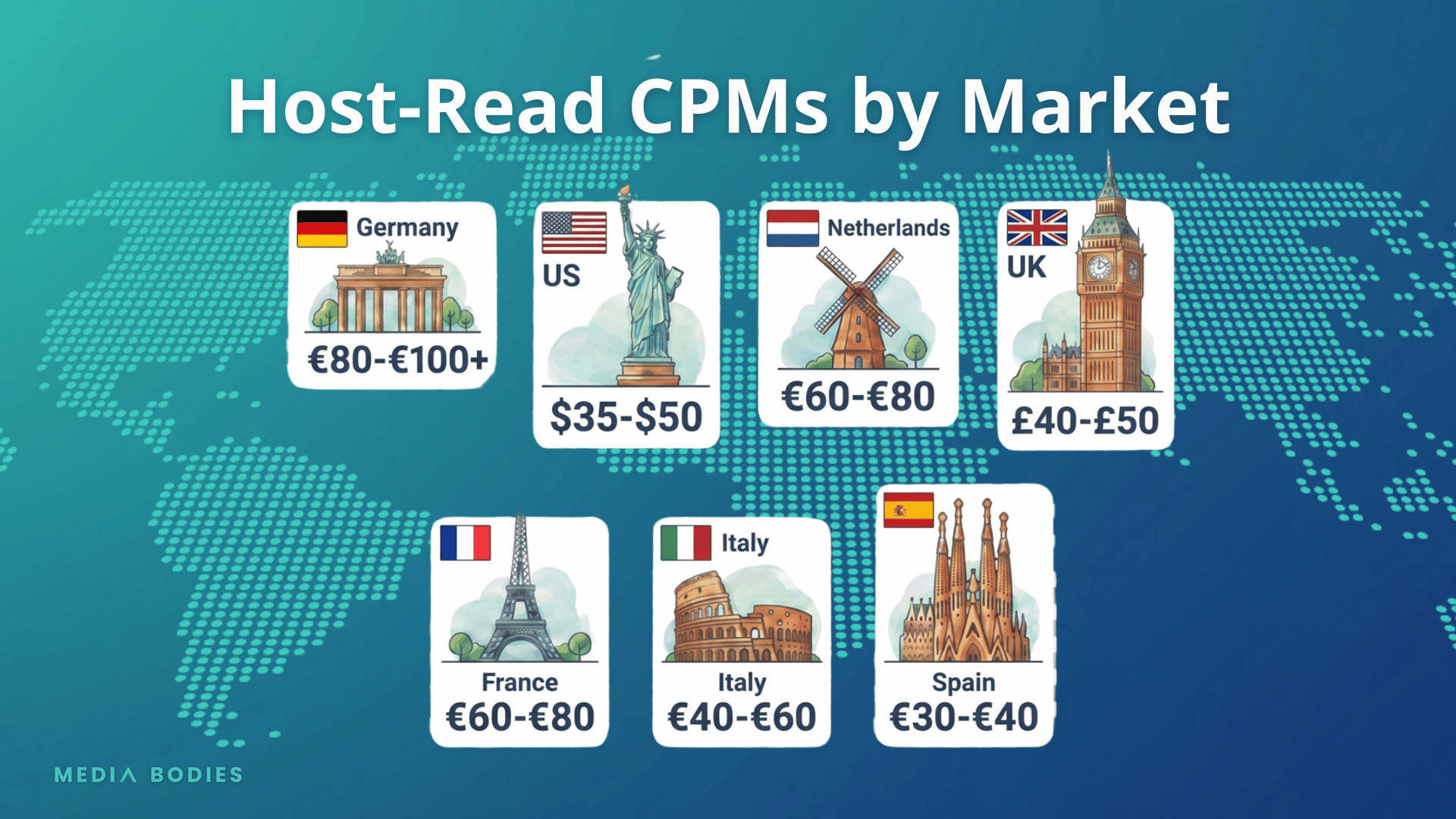
Host-read CPMs vary significantly by country, sometimes by a factor of 3x for the same format. Based on our direct buying data across global markets:
- UK: £40-£50 for host-read placements
- US: $35-$50 for host-read placements
- Germany: €80-€100+ for host-read placements – one of the most expensive podcast markets globally
- Netherlands: €60-€80 for host-read
- France: €60-€80 for host-read
- Italy: €40-€60 for host-read (more reasonable than DACH or France)
- Spain: €30-€40 for host-read (the most accessible major European market)
With any given market, the vertical drives a higher premium. Finance, B2B SaaS, health and crypto-targeted shows command 30-60% more than comparable general interest podcasts in the same country. Premium niche audiences are the most expensive inventory in the entire channel, this is also where the conversion tends to be the strongest.
What factors affect Podcast advertising costs?
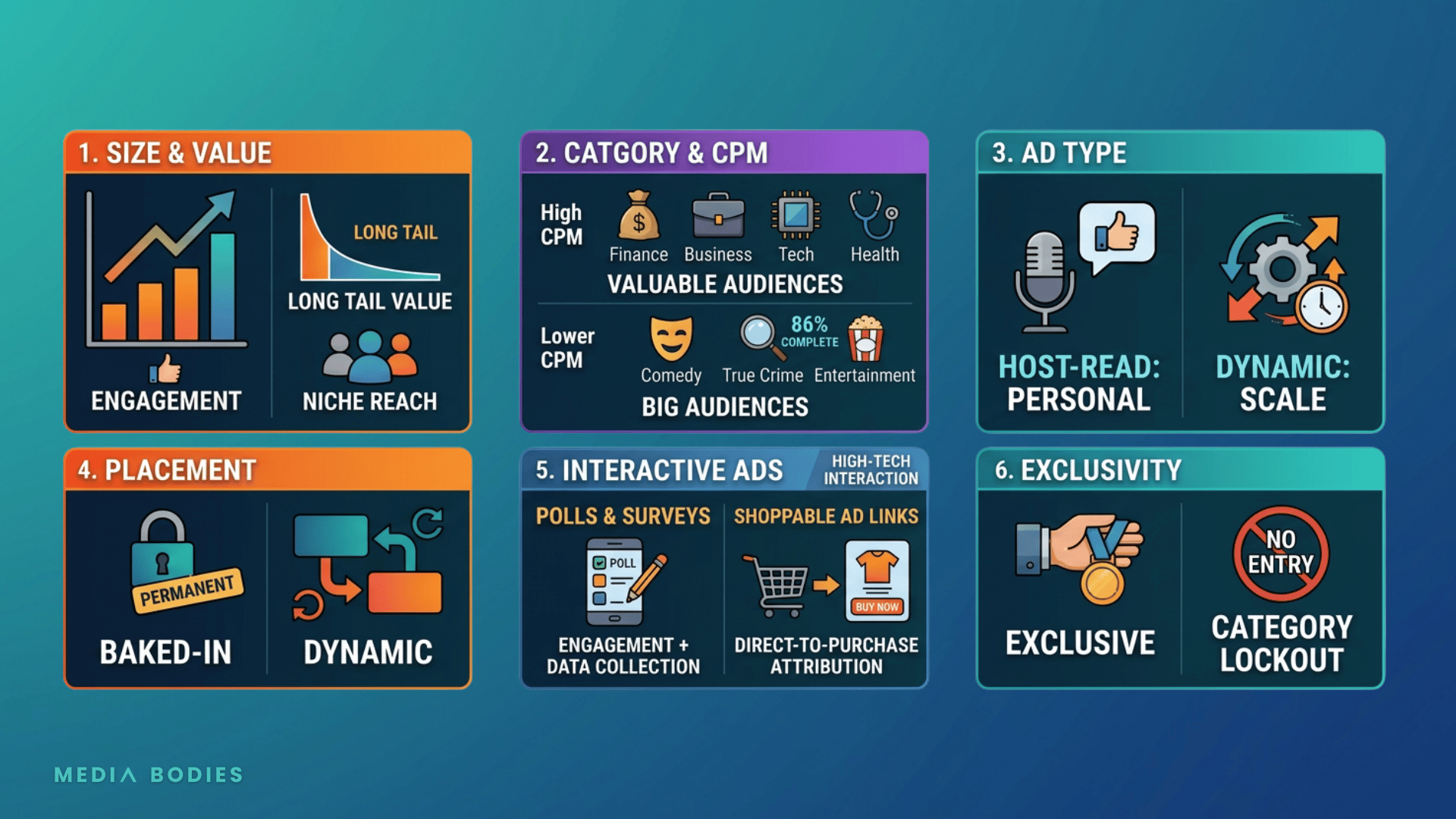
CPM benchmarks are a starting point, not a price list. The variables that actually move the number on the invoice:
Show size matters, but not the way most people think. Yes, larger podcasts with verified download numbers charge more. But the long tail is where the value tends to hide; only 7% of podcasts crack 5,000 downloads per episode, and just 2% reach 20,000+7. Most of the market is mid-tier, and niche shows that are arguably underpriced for the engagement they deliver.
Category drives huge variation. Finance, business, tech and health all command higher CPMs because the audiences are valuable and advertiser competition is fierce. Comedy, true crime and entertainment shows pull bigger numbers but lower CPMs, although true crime in particular hits 86–88% episode completion rates, which makes it surprisingly strong for awareness work even at scale.
Host-read versus produced is the other big lever. Host-read feels native, personal, like a recommendation rather than an interruption. The pricing reflects that. Pre-produced spots dropped in dynamically are cheaper, more scalable, and measurably less effective at driving recall and conversion.
Baked-in versus dynamic is a placement choice with real strategic weight. Baked-in ads are stitched into the episode permanently, so they keep collecting listens from the back catalogue for years. Dynamic ads can be swapped, retargeted and updated mid-flight, the right call for time-sensitive offers or campaigns you want to optimise weekly.
Video podcasts have introduced a new pricing tier in 2026. Vodcast viewers consume 1.5x more content than audio-only listeners (Deloitte), and 44% of vodcast watchers say they’re not multitasking while watching, against 29% for audio. Higher CPMs, but measurably more attention.
Exclusivity costs extra. Sponsoring a show outright, or paying for a category lockout that keeps your competitors off the same listening session, will push the rate up. Whether it’s worth it depends entirely on how protective you need to be of your share of voice.
How much should you budget for a podcast campaign?
Average first-quarter spend per new podcast advertiser hit $42,000 in 2025, that figure is a useful anchor. Realistic budget tiers look like this:
Programmatic test – $5,000 to $15,000. This is an accessible entry point. Programmatic buying via DAI gives you precise audience targeting at a lower CPMs ($5-$18), and $5k-$15k budget is enough to run a credible test, prove attribution and identify which segments respond. You lose the host read endorsement effect, but you get reach and learning fast.
Host-read test – $40,000 to $50,000. A credible direct-sold, host-read test starts here. Most major networks have $10,000-$25,000 minimum spend requirements, which means a meaningful test usually spreads $40k+ across two to four shows over a 4-8 week window. Anything less and you’re either restricted to indie/long-tail shows or unable to gather enough signal to draw a conclusion and optimise for further campaigns.
Growth campaign – $15,000 to $50,000 a month. Four to eight shows running on an ongoing basis. You can build frequency, test different categories side by side, and start optimising on attribution data rather than guesswork. The brand-building effects compound once you’re running consistently.
Category dominance – $200,000+ a month. For brands that want to own a vertical over a sustained period. At this level, you’re buying across multiple networks and show categories, layering host-read with programmatic for frequency, and running an 8-12 week minimum window. The mechanism is consistent, not one-off placements.
Is podcast media buying worth the cost?
Podcast CPMs run higher than display ($2–$10) and sit alongside some social formats. The engagement, though, is in a different league entirely.
Average episode completion rates land around 80%, with the strongest shows hitting 86–93% (Loopex Digital, Q1 2026). Compare that to digital video ads, which complete in the 12–20% range, and the picture changes. Your mid-roll is almost always heard in full.
Recall numbers are high, too. 70% of listeners exposed to podcast ads remember the brand, and 62% report higher intent to seek out the advertised company (eMarketer8, via Ad Results Media). XtendedView9 clocks ad recall on podcasts at 86% – the highest of any media platform they measure.
Action rates back this up. 55%10 of podcast listeners have bought something after hearing it advertised on a podcast (Podsqueeze, 2026). Host-read response rates average 5–9%, compared to 1.5–3.5% for produced ads – a gap that’s almost entirely about listener trust in the host doing the read.
The audience itself helps justify the CPM. Podcast listeners skew educated, high-income, and professionally active. 83% of senior executives listened to a podcast in the past week. 78%11 of business leaders listen weekly. For B2B, SaaS, finance and premium consumer brands, that demographic alone makes the maths work.
The caveat – and we’d be lying if we left it out – is that results vary significantly by show, placement and how well the host relationship is developed. Podcast advertising rewards proper planning and ongoing optimisation more than almost any other channel we work in, which is why working with a specialist podcast advertising agency tends to outperform direct buys on cost and results both.
How does Media Bodies approach podcast ad buying?
The two ways to lose money in podcast advertising are overpaying for the wrong shows and not knowing what’s working when you find the right ones. Both come down to the same thing: walking in without real market relationships and without attribution set up properly.
What we do, in order:
We start with your brand objectives and work out which categories and specific shows your audience already listens to. No money moves until that part is clear.
We negotiate placements and CPM rates directly. That means you pay fair market rates rather than the rack-card pricing that brands going direct often end up with.
We build attribution in from day one. Unique promo codes, custom landing pages, pixel-based tracking, whatever gets you episode-level data rather than aggregate guesswork at the end of the quarter.
We stay on top of format shifts. Video podcasting is reshaping how ads get bought and delivered in 2026, and we structure campaigns so they pull weight across the audio feed, the video episode and the social clips that come out of both.
As a leading global podcast marketing agency, Media Bodies has delivered campaigns for brands across different industries and markets. Our work includes performance-led podcast campaigns for brands such as June’s Journey, WILD Deodorant, Surfshark and RAID: Shadow Legends, helping brands scale through strategic host-read placements, audience targeting and ongoing optimisation.
Whether your first test is a $10,000 programmatic run or you’re scaling a sustained brand play at $250,000+ a month as a podcast marketing agency we make every placement count.
FAQs
What is the average CPM for podcast advertising in 2026?
Host-read podcast advertising CPMs in 2026 typically run $35–$50 in the US, £40–£50 in the UK, and €30–€100+ across Europe. Germany sits at the top end (€80–€100+), Spain at the lower end (€30–€40). Programmatic placements via dynamic ad insertion are significantly cheaper at $5–$18 CPM regardless of market.
How much does a host-read podcast advertising cost?
Host-read mid-roll podcast ads in the US typically cost $35–$50 CPM in 2026, with premium shows in finance, business, health and crypto verticals commanding 30-60% premiums on top. UK rates run £40–£50, and European rates vary widely by country. Host-read ads command a pricing premium because they outperform producer-read ads by 31% on purchase rate (Podscribe, Q2 2025) thanks to the trust the host has built with the audience.
Are podcast ads worth it for small businesses?
Yes, but the entry point depends on the format. Programmatic podcast advertising is genuinely accessible at $5,000–$15,000; you lose the host endorsement effect but get precise audience targeting at lower CPMs. Direct-sold host-read campaigns realistically require $40,000+ test budgets because most major networks have $10k–$25k minimum spend requirements, and you need multiple shows running to gather meaningful signal.
What’s the difference between pre-roll, mid-roll and post-roll podcast ads?
Pre-roll plays in the first 30–60 seconds of an episode (CPM $15–$30). Mid-roll plays partway through, when listener attention peaks (CPM $25–$50+). Post-roll plays after the episode content ends (CPM $10–$20). Mid-roll generates 2–3x higher conversion rates than pre-roll and drives roughly 64% of all podcast ad revenue.
How do you measure ROI on podcast advertising?
Podcast ad ROI is typically measured through unique promo codes, custom landing pages (vanity URLs), pixel-based tracking and post-purchase surveys asking “how did you hear about us?”. Best practice is to combine at least two attribution methods, since podcast listening often happens away from screens and direct-click attribution under-counts true impact.
Is programmatic or direct-sold podcast advertising better?
Direct-sold host-read placements deliver stronger conversion rates and brand recall, while programmatic placements offer cheaper CPMs ($5–$1512) and precise audience targeting at scale. The recommended 2026 approach is to use programmatic for reach and awareness testing, and reserve direct host-read buys for conversion-focused campaigns where listener trust matters most.
Why choose Media Bodies as your trusted podcast advertising partner?
Media Bodies has established relationships across hundreds of podcasts in the US, UK, Canada and Australia, which means brands get fair market CPMs rather than rack-card pricing. Every campaign is built with attribution from day one — unique promo codes, custom landing pages, pixel tracking — so you see episode-level performance rather than aggregate guesswork. The team has been planning and buying podcast advertising daily for years.
How does Media Bodies help brands scale podcast marketing campaigns effectively?
Scaling podcast advertising works when you build on what’s actually performing. Media Bodies typically starts with a test budget of $2,500–$7,500 to establish baseline cost-per-acquisition, then expands into the categories and shows delivering the strongest results. Campaigns run across audio, video and social clips from a single buy, which compounds frequency without inflating CPMs. Attribution data drives every scaling decision.
What makes Media Bodies different from other podcast marketing agencies?
Three things. Media Bodies negotiates directly with shows rather than going through resellers, which means more competitive CPMs and faster turnaround. Attribution is built in from day one rather than bolted on at the end — every campaign produces episode-level data. And campaigns are structured across audio feed, video episode and social clips as standard, rather than treated as separate buys that fragment your budget.